
Use Case

Fundraising narrative pressure test

This is for you if you are building at pre-seed, seed, Series A and need a decision before your next investor conversation. Best moment: Use this two to three days before partner meetings, then refresh after every three to five investor calls.

What you should do

Rewrite the story as a decision chain: bottleneck, proof, economics, and moat, with explicit evidence for each link.

Decision: What story changes should I make before the next investor meeting so objections drop?

Next this week: Pressure-test your fundraise story.

Fundraising narrative pressure test hero image
how to pressure test a fundraising story with evidence and clear investor objections

Decision narrative

Key takeaways

  • A compelling deck is a testable argument, not a slide collection.
  • Prioritize the three objections that most often block conviction.
  • Replace broad claims with concrete proof and explicit caveats.
  • Treat each investor meeting as calibration data for the next revision.
  • Keep one source map so numbers stay consistent across deck, memo, and Q&A.

Why now

Fundraising markets reward clarity under pressure: vague growth or moat language is discounted quickly in partner discussions.

  • When the story fails, teams often over-edit slides instead of fixing the logic chain between market pain, product proof, and value capture.
  • A pressure-test process turns investor feedback into a prioritized revision queue that compounds meeting-to-meeting.
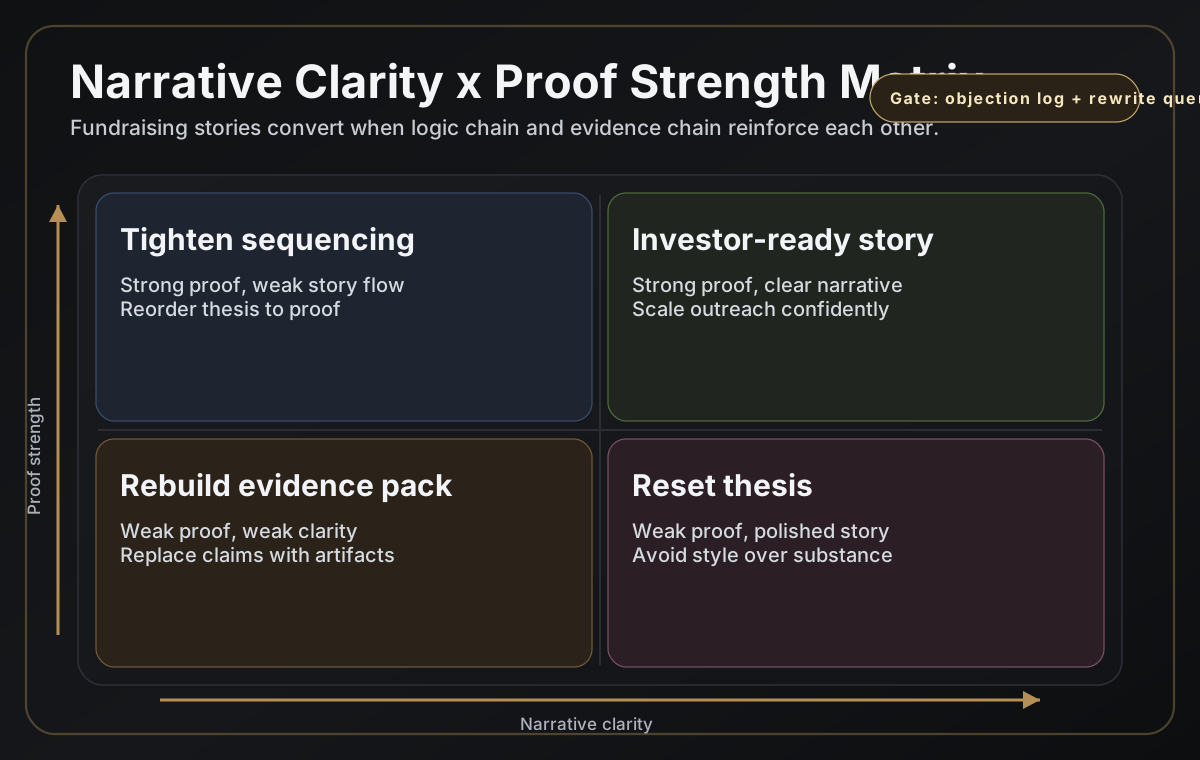
What breaks without this

Teams ship new deck versions but keep the same unproven assumptions, so objections remain unchanged.

  • Metrics drift across materials because no single source map exists for numbers and caveats.
  • Partner Q&A exposes narrative contradictions that were invisible in async deck review.

Decision framework

Link every major claim to one proof source, one caveat, and one expected investor question.

  • Rank objections by conversion impact and answerability within your next revision cycle.
  • Use a go/hold rule: if a core claim has no defensible proof path, rewrite scope before the next meeting.

Recommended path

Run a weekly narrative calibration loop: capture objections, update source map, revise highest-impact sections first.

  • Keep storyline simple and concrete: what breaks today, why your product is uniquely positioned, and how value compounds.
  • Use explicit caveats to preserve trust rather than hiding uncertainty with broad language.

Implementation sequence

Week 1: map current storyline and tag unsupported claims.

  • Week 2: rewrite three highest-risk sections with source-backed evidence and objection-ready answers.
  • Week 3+: run meeting-by-meeting feedback loop and track conversion movement by narrative change.

Tradeoffs and counterarguments

Some teams worry that caveats weaken the pitch; in practice, defensible caveats increase investor trust.

  • Full narrative rigor can feel slower, but it reduces costly reset cycles during live raises.
  • The best balance is concise storytelling with explicit evidence links for all high-stakes claims.

Decision matrix

Decision matrix
Decision matrix
CriterionRecommended whenUse caution when

Your metrics are improving but investor conviction is not.

You are raising in the next quarter and need rapid narrative iteration.

You are not fundraising soon and can focus on product execution first.

You need tighter links between bottleneck, product motion, and value capture.

Investor meetings repeat the same objections on risk, moat, or GTM.

The team cannot support rapid source-backed revisions between meetings.

Your team wants concrete edits for next deck iteration, not abstract advice.

Your team needs a shared source map for every quantitative claim.

The objective is only visual deck polish rather than narrative integrity.

Decision criterion 4

You want edit priority tied to conversion impact, not slide aesthetics.

Legal constraints prevent sharing supporting evidence for critical claims.

Execution flow

System flow

Fundraising story stress-test flow

  1. Current narrative
  2. Objection map
  3. Evidence gaps
  4. Rewrite priorities
  5. Pitch gate
Logic chain survives partner Q&A

Story holds

  • Standardize deck + memo language
  • Train objection responses
  • Track conversion by segment
Repeated objections on same claim

Revise

  • Edit thesis and proof sequence
  • Tighten value-capture narrative
  • Validate with next investor loop
Core story lacks internal consistency

Reset framing

  • Re-state bottleneck
  • Re-scope market and wedge
  • Delay broad outreach until fixed

Weekly loop

Meeting loop: capture objections, reprioritize edits, and ship the next story iteration weekly.

Before

You are not fundraising soon and can focus on product execution first.

After

Finds narrative gaps between problem framing and commercial model.

Evidence snapshot

Evidence lens

Founders often get one short window to establish conviction, making first-pass clarity critical.

2medium

DocSend • 2024-01-09 • industry survey

DocSend Pitch Deck Metrics
Details

Metric context

Average deck read time is about 2 minutes 30 seconds.

Caveat

Sample skews to DocSend users and may not represent every fundraising context.

Raising climate remains selective, which increases the penalty for unclear positioning.

4Kmedium

NVCA + PitchBook • 2026-01-15 • industry survey

PitchBook-NVCA Venture Monitor
Details

Metric context

Q4 2025 US VC deal value was $87.5B across 3,968 deals.

Caveat

Aggregate deal volume does not indicate fit for individual companies.

Seed extension pressure is still material, increasing the need for narrative precision and milestone credibility.

46%medium

Carta • 2026-02-18 • industry survey

State of Private Markets Q4 2025
Details

Metric context

46% of US seed rounds in Q1 2025 were bridge rounds.

Caveat

Round-structure patterns vary by sector and investor composition.

Evidence-backed claims matter because AI productivity narratives are now scrutinized at proof-level detail.

+14%high

National Bureau of Economic Research • 2023-11-14 • working paper

Generative AI at Work (NBER Working Paper w31161)
Details

Metric context

+14% issues resolved per hour with AI assistant access.

Caveat

Do not generalize blindly; show why your context is comparable.

Investors increasingly expect explicit governance framing around AI claims and risk controls.

4high

National Institute of Standards and Technology • 2023-01-26 • gov publication

NIST AI Risk Management Framework 1.0
Details

Metric context

4 AI RMF functions for operating governance.

Caveat

Use framework language to clarify controls, not to inflate readiness claims.

Known LLM failure classes can be translated into investor-facing risk disclosures and mitigation plans.

Top 10medium

OWASP GenAI Security Project • 2025-01-23 • industry survey

OWASP Top 10 for LLM Applications Project Update
Details

Metric context

Top 10 LLM application risk classes (v1.1 update).

Caveat

Risk categories need company-specific controls and accountable owners.

Who this is not for

You are not fundraising soon and can focus on product execution first.

Why: This usually signals unresolved ownership or data readiness constraints.

The team cannot support rapid source-backed revisions between meetings.

Why: This usually signals unresolved ownership or data readiness constraints.

The objective is only visual deck polish rather than narrative integrity.

Why: This usually signals unresolved ownership or data readiness constraints.

Legal constraints prevent sharing supporting evidence for critical claims.

Why: This usually signals unresolved ownership or data readiness constraints.

FAQ

Will this rewrite our whole deck?

No.

Read full answer

It prioritizes the highest-leverage narrative fixes first, then sequences optional deeper rewrites.

Can this support post-seed rounds?

Yes.

Read full answer

The framework adapts, but evidence expectations rise as stage increases.

Actionable next step

Get high-impact edits before your next investor loop.

Pressure-test your fundraise story