
Use Case

Pre-seed deck triage in 24 hours

This is for you if you are building at pre-seed, seed and need a decision before your next investor conversation. Best moment: Use this 24-48 hours before your first partner meeting, then use the follow-up questions the same day after.

What you should do

Run deck triage as a confidence-gated diligence system: score each claim, surface missing evidence, and decide go-deeper versus pass in 24 hours.

Decision: Should we spend the next partner meeting on this deck, and what evidence should I prep first?

Next this week: Submit a deck for triage.

Pre-seed deck triage in 24 hours hero image
how to triage pre-seed decks fast without lowering decision quality

Decision narrative

Key takeaways

  • Treat triage as a repeatable operating system, not a one-off partner opinion.
  • Prioritize claims that change investment downside, not cosmetic deck quality.
  • Require explicit evidence requests for every high-impact unknown.
  • Use abstain or pass when uncertainty is unbounded instead of forcing false confidence.
  • Review weekly outcomes to recalibrate thresholds and reduce repeat misses.

Why now

Seed investors are seeing more AI-native decks while partner review bandwidth has not scaled at the same rate.

  • The operational question is not whether a deck sounds compelling, but whether the highest-risk assumptions are testable before deeper partner time is committed.
  • A 24-hour triage pass protects partner focus by turning noisy inbound into a ranked queue of decision-grade opportunities.
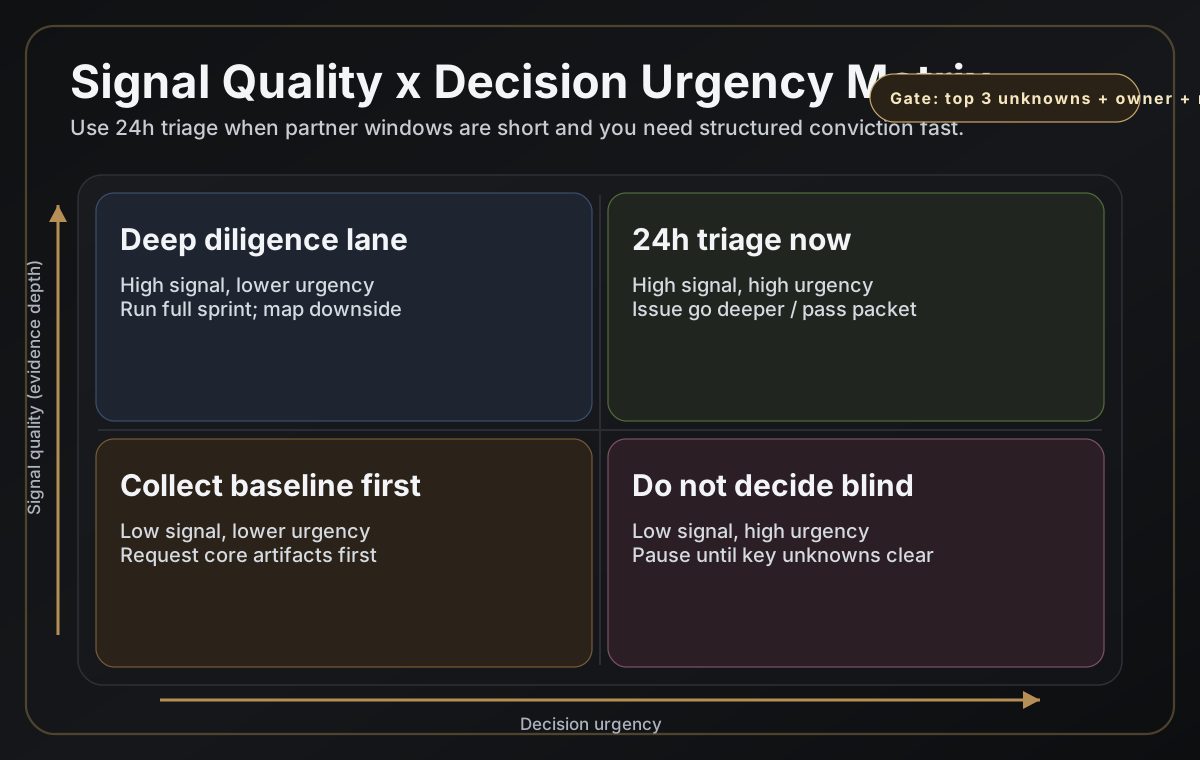
What fails without this

Without a structured triage rubric, teams overweight storytelling polish and underweight unresolved execution risk.

  • Important uncertainty goes undocumented, so the same objections reappear later in partner meetings and IC discussions.
  • Time spent on weak opportunities crowds out higher-quality deals that needed faster response and clearer follow-up requests.

Decision framework

Step 1: score the deck against bottleneck, advantage, integrity, and operating feasibility with explicit confidence tags.

  • Step 2: classify each high-impact claim as verified, partially supported, or unverified and generate precise evidence requests.
  • Step 3: route to one of three outcomes: go deeper, hold for evidence, or pass with rationale.

Recommended path

Default to a confidence-gated triage lane where low-confidence high-liability claims cannot pass without additional evidence.

  • Anchor decisions to a short written rationale that can be audited by partners and reused during follow-up.
  • Only scale volume after weekly scorecard review shows stable precision and acceptable miss-recovery cost.

Implementation sequence

Week 1: baseline current review outcomes and define go-deeper/pass criteria.

  • Week 2: launch constrained triage on one deal segment with mandatory evidence requests.
  • Week 3+: review outcomes weekly and tune thresholds based on miss patterns and partner feedback quality.

Tradeoffs and counterarguments

A structured system can feel rigid versus pure partner intuition, but it prevents high-cost inconsistency at volume.

  • Not every company needs this depth; low-volume firms with narrow thesis focus may run lighter triage.
  • The right compromise is structured first-pass triage plus partner judgment for edge-case domain nuance.

Decision matrix

Decision matrix
Decision matrix
CriterionRecommended whenUse caution when

You need a lens on value capture, not only TAM and growth claims.

You need first-pass diligence outcomes inside one working day.

A term sheet is already in final legal negotiation and only legal diligence remains.

You can provide deck + product context asynchronously in one business day.

Partner bandwidth is constrained and you must rank opportunities by decision impact.

The team cannot access core artifacts needed to validate key claims.

You want follow-up diligence questions ranked by decision impact.

You can request targeted follow-up evidence from founders quickly.

The process owner cannot run a weekly calibration loop.

Decision criterion 4

You need a written rationale for every go-deeper or pass outcome.

You only need visual deck polish feedback, not investment decision support.

Execution flow

System flow

24-hour structured diligence flow

  1. Deck intake
  2. Lens scoring
  3. Evidence map
  4. Partner packet
  5. Decision gate
Strong signal + bounded unknowns

Go deeper

  • Launch focused diligence sprint
  • Assign owners for top open questions
  • Set next decision date
Mixed signal or missing evidence

Hold

  • Request specific founder artifacts
  • Re-score after evidence update
  • Track unresolved assumptions
Weak signal or structural risk

Pass

  • Record rationale clearly
  • Avoid repetitive re-review
  • Preserve notes for future revisit

Weekly loop

Weekly loop: calibrate score thresholds against win/loss outcomes.

Before

A term sheet is already in final legal negotiation and only legal diligence remains.

After

Frames bottleneck, compounding advantage, architecture, and integrity in one scorecard.

Evidence snapshot

Evidence lens

Assistive AI can increase knowledge-worker throughput in real workflows when usage is constrained and measured.

+14%high

National Bureau of Economic Research • 2023-11-14 • working paper

Generative AI at Work (NBER Working Paper w31161)
Details

Metric context

+14% issues resolved per hour with AI assistant access (study of 5,179 support agents).

Caveat

Single-firm context; validate impact against your own diligence workflow.

Productivity gains are often largest for less-experienced operators, which matters for first-pass review throughput.

+34%high

National Bureau of Economic Research • 2023-11-14 • working paper

Generative AI at Work (NBER Working Paper w31161)
Details

Metric context

+34% productivity lift for novice and low-skill workers.

Caveat

Effect size depends on baseline process quality and training.

Current aggregate studies show measurable time and labor-productivity upside from genAI assistance.

5.4%medium

Federal Reserve Bank of St. Louis • 2025-02-27 • gov publication

The Impact of Generative AI on Work and Productivity
Details

Metric context

5.4% average time savings and +1.1% aggregate labor productivity effect.

Caveat

Includes survey and model assumptions, not only observed operational telemetry.

AI governance should be explicit and operationalized, not left as ad hoc reviewer behavior.

4high

National Institute of Standards and Technology • 2023-01-26 • gov publication

NIST AI Risk Management Framework 1.0
Details

Metric context

4 core AI RMF functions (Govern, Map, Measure, Manage).

Caveat

Framework guidance still needs workflow-specific controls and ownership.

Generative AI use cases should include profile-level risk controls before broad rollout.

AI 600-1high

National Institute of Standards and Technology • 2024-07-26 • gov publication

AI RMF Generative AI Profile (NIST AI 600-1)
Details

Metric context

AI 600-1 profile for generative AI risk treatment.

Caveat

Apply profile controls proportionally to diligence risk class.

LLM application risk is now codified enough to enforce minimum guardrails in decision workflows.

Top 10medium

OWASP GenAI Security Project • 2025-01-23 • industry survey

OWASP Top 10 for LLM Applications Project Update
Details

Metric context

Top 10 LLM application risk classes (v1.1 update).

Caveat

Security taxonomy is not a substitute for control testing.

Who this is not for

A term sheet is already in final legal negotiation and only legal diligence remains.

Why: This usually signals unresolved ownership or data readiness constraints.

The team cannot access core artifacts needed to validate key claims.

Why: This usually signals unresolved ownership or data readiness constraints.

The process owner cannot run a weekly calibration loop.

Why: This usually signals unresolved ownership or data readiness constraints.

You only need visual deck polish feedback, not investment decision support.

Why: This usually signals unresolved ownership or data readiness constraints.

FAQ

How quickly can this be run?

Most submissions are assessed within one working day once deck context is complete.

Is this a final investment decision?

No.

Read full answer

It is a decision-support layer that helps prioritize where to spend partner attention.

Actionable next step

Share deck + context, get a structured diligence read quickly.

Submit a deck for triage