Why now
- The common failure is governance and operating-model drift, not model capability alone.
- A readiness check creates a pre-commitment contract: what must be true before launch, what triggers hold, and what forces rollback.
Use Case
This is for you if you are building at seed, Series A. Best moment: Use this before pilot kickoff or security review, then re-check before renewal and expansion conversations.
What you should do
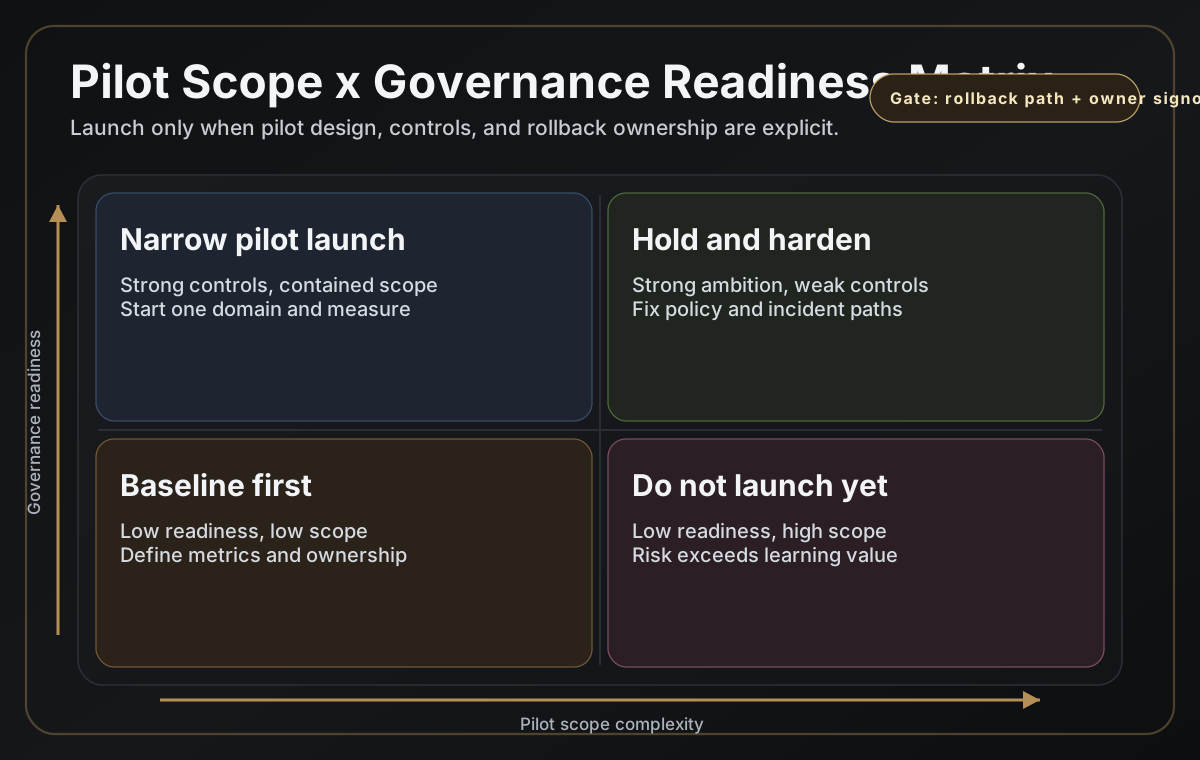
Ship pilots only when value metrics, risk controls, and owner accountability are explicit; otherwise hold scope and fix prerequisites.
Decision: Should we launch this enterprise pilot now, or tighten scope before we promise customer outcomes?
Next this week: Upload your deck for a First Look.

Key takeaways
Why now
What breaks without this
Decision framework
Recommended path
Implementation sequence
Tradeoffs and counterarguments
| Criterion | Recommended when | Use caution when |
|---|---|---|
You need pilot scope tied to measurable economic outcomes. | A design partner is ready but success criteria are still negotiable. | The team cannot define objective success and stop criteria before launch. |
Your customer champion and buyer are not yet the same stakeholder. | You need a measurable expansion story tied to real buyer economics. | No owner is accountable for policy, reliability, and escalation outcomes. |
You need explicit criteria for expansion versus pilot sunset. | Security, legal, and operations teams can participate in launch gating. | The pilot requires irreversible automation in high-liability flows. |
You can enforce rollback and incident playbooks before go-live. | Customer commitments are already fixed and cannot be reshaped safely. |
System flow
Pilot-to-expansion readiness flow
Weekly loop
Release loop: evaluate quality, adoption, and expansion economics before scaling.
Evidence lens
Enterprise AI governance should be implemented as an operating model, not a static policy document.
National Institute of Standards and Technology • 2023-01-26 • gov publication
NIST AI Risk Management Framework 1.0Metric context
4 AI RMF operating functions (Govern, Map, Measure, Manage).
Caveat
Framework defines structure; local controls and accountability remain implementation-specific.
Generative AI deployment risk can be profiled before launch to reduce policy ambiguity.
National Institute of Standards and Technology • 2024-07-26 • gov publication
AI RMF Generative AI Profile (NIST AI 600-1)Metric context
AI 600-1 generative AI profile for control design.
Caveat
Profile alignment improves consistency but does not replace incident drills.
Known LLM application failure classes are now explicit enough to enforce pre-launch guardrails.
OWASP GenAI Security Project • 2025-01-23 • industry survey
OWASP Top 10 for LLM Applications Project UpdateMetric context
Top 10 LLM application risk classes (v1.1 update).
Caveat
Risk classes require environment-specific threat modeling and control testing.
Measured productivity effects from assistive AI indicate pilots can create real throughput gains when governed.
National Bureau of Economic Research • 2023-11-14 • working paper
Generative AI at Work (NBER Working Paper w31161)Metric context
+14% issues resolved per hour with AI assistant access.
Caveat
Single-company context; expected lift varies with workflow readiness.
External macro analysis still supports non-trivial labor-productivity upside from genAI adoption.
Federal Reserve Bank of St. Louis • 2025-02-27 • gov publication
The Impact of Generative AI on Work and ProductivityMetric context
+1.1% aggregate labor productivity effect with genAI-assisted work.
Caveat
Macro estimate; pilot-level results depend on local operating constraints.
Venture deployment pressure in AI raises the cost of launching pilots without strong gates.
NVCA + PitchBook • 2026-01-15 • industry survey
PitchBook-NVCA Venture MonitorMetric context
65.6% of Q4 2025 US VC deal value concentrated in AI/ML.
Caveat
Capital concentration signals pressure, not guaranteed customer value.
The team cannot define objective success and stop criteria before launch.
No owner is accountable for policy, reliability, and escalation outcomes.
The pilot requires irreversible automation in high-liability flows.
Customer commitments are already fixed and cannot be reshaped safely.
What makes this different from a sales checklist?
It links technical architecture, data flywheel, and commercial expansion criteria in one framework.
Can this run before code is fully production-ready?
Yes.
It is most useful before implementation is locked so pilot design can still change.
See where your deck's case for adoption and reliability needs stronger evidence before you promise pilot outcomes.
Upload your deck for a First Look